IFMSA’s Contributions to SB62: Championing Health in Climate Negotiations
Written by: Wing Tung Rachel Cheung (SCOPH External Affairs Assistant for Advocacy)


Overview of the 62nd Session of the UNFCCC Subsidiary Bodies (SB62)
The 62nd session of the United Nations Framework Convention on Climate Change (UNFCCC) Subsidiary Bodies (SB62) took place from June 16 to 26, 2025, in Bonn, Germany. As a critical preparatory meeting for COP30 in Belém, Brazil, SB62 convened governments, UN agencies, civil society, and youth representatives to discuss pressing climate issues.
The focus of the session was on climate equity and justice for vulnerable populations, with key negotiation areas including adaptation, mitigation, loss and damage, just transition, and finance. Health emerged as a central theme across multiple streams, emphasising the need to build climate-resilient health systems, address health inequities, and leverage the health co-benefits of climate action.
Representing the International Federation of Medical Students’ Associations (IFMSA), I had the privilege of advocating for the integration of health into global climate policies. Building on IFMSA’s contributions at COP28, COP29, and SB60, SB62 was another opportunity to ensure that health remains a priority in climate negotiations.
IFMSA Advocacy Goals at SB62
 At SB62, IFMSA pursued the following advocacy objectives:
- Advocating for health inclusion in key negotiation streams, such as adaptation, mitigation, and loss and damage.
- Amplifying youth voices on climate and health in discussions and side events.
- Coordinating with health stakeholders to align strategies for unified advocacy.
- Participating in impactful side events to showcase IFMSA’s work on planetary health and youth-led climate action.
Key Negotiation Outcomes and Health Links
Adaptation
Global Goal on Adaptation (GGA):
- Parties agreed to streamline adaptation indicators from 489 to fewer than 100, focusing on enabling factors, means of implementation (MOI), and cross-cutting considerations.
- Frameworks such as the Baku Adaptation Roadmap and transformational adaptation were identified as vital tools for implementing the GGA.
- Developing countries called for greater commitments to build confidence in meeting adaptation needs, particularly in terms of finance and MOI.
Health Integration in Adaptation:
- Health was highlighted as a cross-cutting priority in adaptation discussions.
- Key areas included addressing heatwaves, vector-borne diseases, and climate-related disasters, with an emphasis on building capacity through National Adaptation Plans (NAPs).
Loss and Damage
Warsaw International Mechanism (WIM):
- Discussions on the review of the WIM and the Joint Annual Report of the Santiago Network were forwarded to COP30.
- Developing countries emphasized the urgent need for adequate funding and technical guidelines to operationalize the Loss and Damage Fund.
Health Impacts of Loss and Damage:
- The disproportionate burden on health systems in vulnerable regions was a key concern, particularly through displacement, disease outbreaks, and resource losses.
Mitigation
Mitigation Work Programme (MWP):
- The MWP was marked by disagreements over its scope and ambition, with developing countries emphasizing national sovereignty and developed countries pushing for stronger commitments aligned with the Paris Agreement.
- Brazil’s proposal for a digital platform linking mitigation projects with financing received mixed reactions.
Health Co-Benefits of Mitigation:
- Actions such as transitioning to renewable energy and reducing air pollution were highlighted for their public health benefits, including lower rates of respiratory illnesses and reduced healthcare costs.
Just Transition
Progress on the Just Transition Work Programme (JTWP):
- Draft text included strong language on equity, participation, and rights, but disagreements over finance and energy transitions remained unresolved.
Health in Just Transition:
- Discussions emphasized the importance of including healthcare systems in just transition strategies, particularly in regions heavily reliant on fossil fuels.
Finance
Baku to Belém Roadmap:
- The roadmap for $1.3 trillion in climate finance was a central focus, with developing countries expressing frustration over the lack of clarity regarding its implementation.
- Calls were made for a new finance goal to replace the expiring COP26 commitment to double adaptation finance by 2025.
Health and Climate Finance:
- IFMSA and the health community advocated for dedicated funding streams to support health adaptation measures and address health inequities, emphasizing the urgency of building climate-resilient health systems.
IFMSA Involvement at SB62

As the SCOPH External Affairs Assistant for Advocacy, I took on several responsibilities during SB62 to elevate health in climate discussions:
Advocating for Health in Negotiations:
- I actively followed discussions on the Global Goal on Adaptation (GGA), loss and damage, and just transition, contributing to the integration of health priorities into these streams

Health Community Coordination:
- I attended daily Global Climate and Health Alliance (GCHA) coordination meetings, where I collaborated with IFMSA’s partners to align advocacy strategies

Youth-Led Advocacy:
- I worked closely with the YOUNGO Health Working Group to amplify youth perspectives in climate governance, particularly on the intersection of health and climate action.
- I participated in youth-led side events and discussions, making interventions that underscored the urgency of addressing climate-related health inequities.

Advocacy Actions:
- I led the organization of the Code Blue: Climate Crisis is a Health Crisis action, a powerful demonstration that raised awareness about the health impacts of climate change.

Networking and Collaboration:
- I engaged with key stakeholders, including the Global Climate and Health Alliance (GCHA), United for Global Mental Health (UGMH), Lancet Countdown to strengthen partnerships and explore opportunities for collaboration leading up to COP30

Side Event Participation:
- I represented IFMSA at several impactful side events, actively contributing to discussions on SRHR and gender equality, urban climate action, and climate-resilient health systems.
Advocacy Actions: Code Blue – Climate Crisis is a Health Crisis
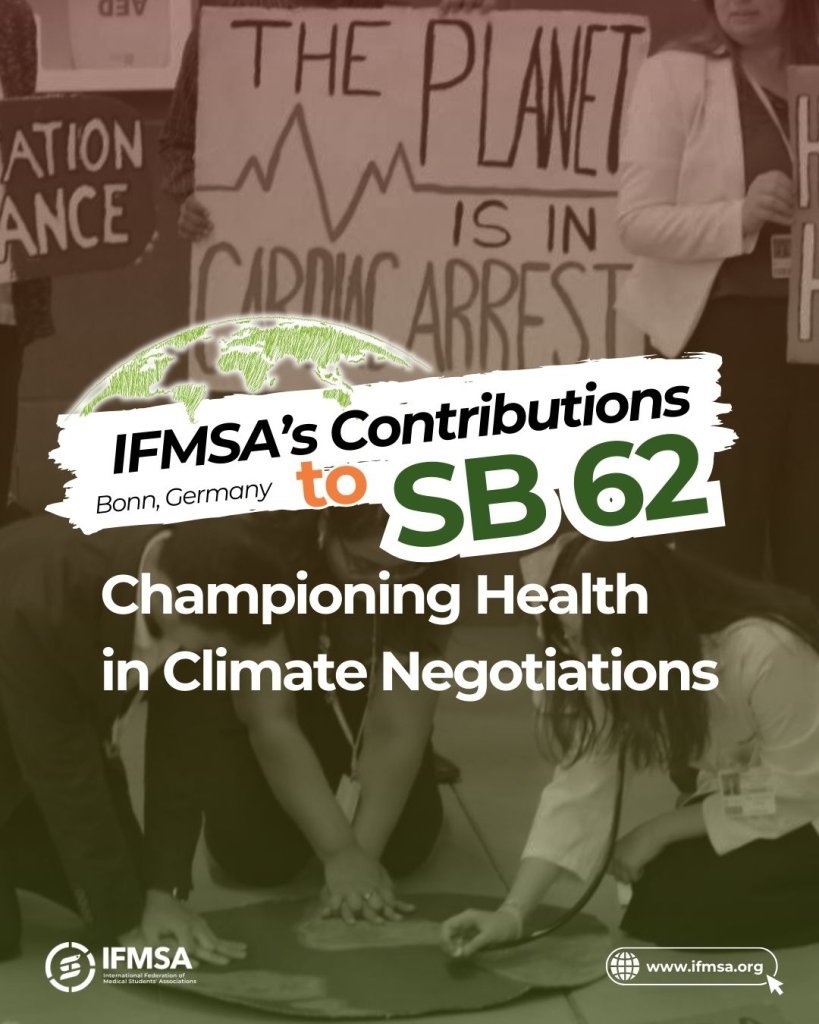
 One of the most memorable moments of SB62 was the Code Blue: Climate Crisis is a Health Crisis advocacy action, led by IFMSA and supported by IPSF, YOUNGO Health, and the WHO Youth Council.
Key Highlights:
- Objective: To raise awareness of the health impacts of climate change and push for urgent action on clean energy, adaptation finance, and resilient health systems.
- Symbolic Activities:
- CPR on the Globe: Representing the resuscitation of a critically ill planet.
- Listening to the Planet’s Heartbeat: Using stethoscopes to symbolize the worsening state of the Earth’s health.
- Prescription for the Planet: Offering solutions such as clean energy transitions and increased adaptation finance.
- Key Messages:
- End fossil fuel dependence to prevent air pollution-related deaths.
- Increase climate finance for adaptation and loss and damage.
- Build climate-resilient health systems to address heatwaves, floods, and disease outbreaks.
- This action garnered significant attention and media coverage, amplifying the message that climate action is a health priority. Our action was also covered by NilePost, you can check it out here!
Side Events: Health-Centered Discussions

SB62 featured impactful side events that showcased the intersection of health and climate:
- Navigating the Climate of Change: A Journey through SRHR and Gender Equality
- Highlighted how climate change disrupts access to sexual and reproductive health services (SRHR) and exacerbates gender inequities.
- Advocated for gender-transformative climate action that prioritizes marginalized populations.
- Cities Leading the Way: Advancing Healthy and Just Transitions Through Urban Climate Action
- Explored participatory frameworks for urban adaptation, including climate hazard mapping and vulnerability assessments.
- Promoted nature-based solutions like urban tree planting for improved public health and mental well-being.
- Building Climate-Resilient Health Systems: Action for Health in the Global Climate Agenda
- Showcased initiatives such as Mozambique’s Health National Adaptation Plan (H-NAP) and the ATACH initiative.
- Emphasized cross-sectoral collaboration, financing, and data collection to enhance health system resilience.
Looking Ahead to COP30
As we prepare for COP30 in Belém, Brazil, IFMSA is committed to building on the progress made at SB62. Key priorities include:
- Strengthening youth leadership in climate-health advocacy.
- Advocating for health-centered adaptation, mitigation, and finance strategies.
- Collaborating with partners to ensure health remains a central focus in global climate action.
SB62 reaffirmed that health is at the heart of climate justice. By continuing to advocate for bold, equitable action, we can create a healthier, more sustainable future for all.