
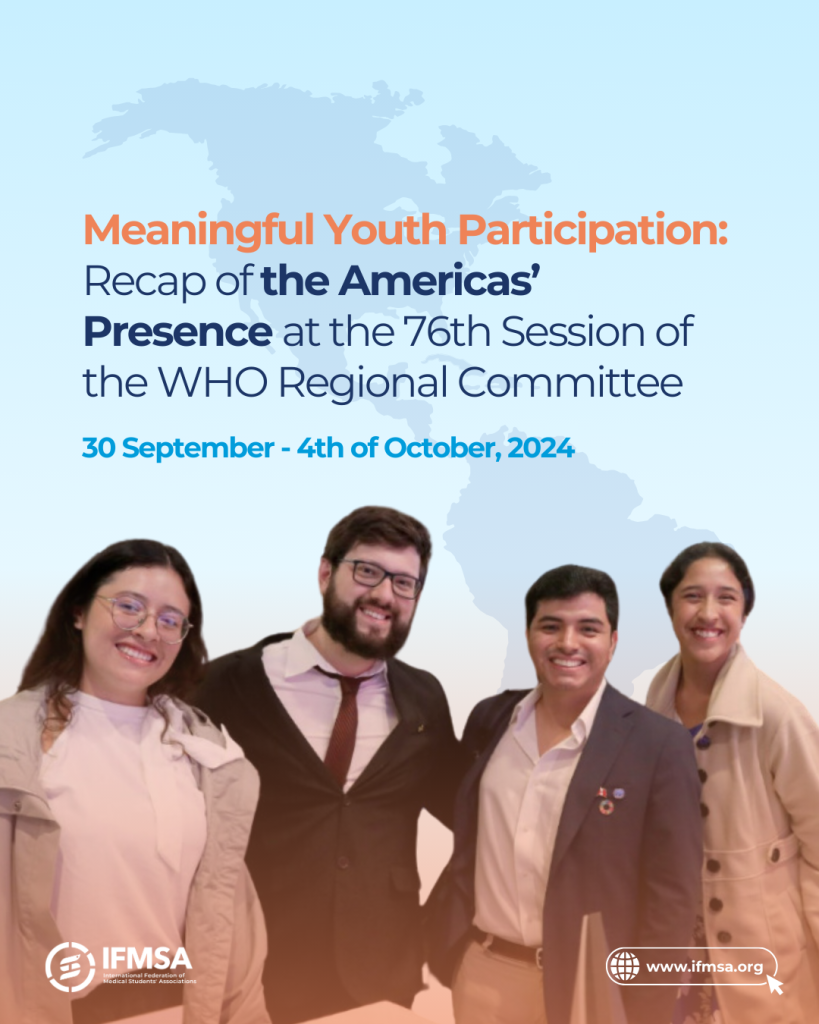
Written by Diego Bustos Castillo, EA Regional Assistant for the Americas
The Pan American Health Organization (PAHO) is the specialized international health agency for the Americas. It works with countries throughout the region to improve and protect people’s health.
To advance these goals, PAHO promotes technical cooperation between countries and works in partnership with ministries of health and other government agencies, civil society organizations, other international agencies, universities, social security agencies, community groups, and other partners.
As the IFMSA established a long partnership since 2013, both our Federation and the PAHO promote the inclusion of health in all public policies and the engagement of all sectors in efforts to ensure that people live longer, healthier lives, with good health as their most valuable resource.
Regarding the 5 day event, the WHO RC established a Program policy issues debate, Administrative and financial matters, and Selection of Member States for membership on councils and committees, among other things, on which our delegates represent our powerful and diverse region.
The 76th WHO RC took place in Washington DC, from November 30th to October 4th of this year, and the attendants from the International Federation of Medical Students Associations were:
- [Regional Director for Americas] Dr. Marcelo Manturano
- [IFMSA Brazil] Gustavo H. N. Dalle Cort
- [IFMSA-Perú] Susana Seminario
- [ASCEMCOL-Colombia] Marilyn Castro
Key IFMSA Americas achievements


External partnerships
The Americas region has generated several links to strengthen its External Affairs in terms of new opportunities and platforms for medical students to raise their voices.
Institutions such as the Pan American Federation of Association Medical Schools (PAFAMS), Pan American Health Organization (PAHO) offices for Health, United Nations Children Fund for Latin America and Caribe (UNICEF LACRO), and the World Organization of Family Doctors (CIMF-WONCA) will be key in the progress of the Federation’s institutional linkages. The purpose of these talks will be to reestablish new meetings, fulfill the existing Memorandum of Understandings (MoUs), and seek mutual benefit in making the regional priorities and strategies a reality, not just a virtual concept.
Several of these new approaches have re-engaged our stakeholders, and we have established new online communication channels. In this way, and thanks to the advocacy process, we will be able to offer more and better opportunities during the period for the members of the region, who see IFMSA as a platform that transcends the clinical but strives to fulfill the dreams of young leaders in search of better health for their people.
Engagement and networking knowledge

The Regional Committee provides an essential platform for medical students to engage with relevant stakeholders, such as NGOs, policymakers, and public health actors. During the 76th World Health Organization Regional Committee, the IFMSA delegation focused on advancing our beliefs as a federation of medical students and the importance of youth action.
During this event, we formed new partnerships with the Pan American Health Organization, its departments, and strong non-state actors, such as the Health Latin America Coalition (CLAS). We also meet old allies, such as the World Organization of Family Doctors (WONCA), who align with IFMSA’s quest for a holistic approach to health.
With great honor, the IFMSA delegation was personally invited to compose a debate with other non-state actors to talk about social participation in the Health System, share experiences, and share visions to better it. This moment was organized by the Brazilian National Health Council and PAHO Department for Health Systems and Services: Human Resources for Health.
At last, our delegates also had the chance to engage with those representing their countries and even other countries, strengthening our National Member Organizations (NMOs) in the region and the support they receive from their government. IFMSA was presented to national representatives from Brazil, Colombia, Peru, Chile, El Salvador, Mexico, Panama, Ecuador, and more.
The role of medical students in our countries
The medical students of each country are not only the future of health; they are the present, and our voices count now more than ever. This platform reinforces the premise that IFMSA does not represent only students who learn in the classroom. Still, they are young people with passion and commitment to change the course of their sanitary context within their countries, being able to transform public health and lend a hand and accompany the communities that need the most.
As medical students, our mission is more than just to study. Our mission is to say that we make our mark by fighting for justice, equity, and access to health care for all and that together, we will be the change the world needs.
The statements: taking stances in our region

 Several reports were delivered at the event regarding the progress of reaching the goals towards 2030. Many of them did not meet our expectations, and as medical students, we took positions associated with our current policy documents on these topics. These documents are evidence-based positions that seek to encompass our efforts on contingent issues relevant to global health.
We are proud to report that the seven statements developed by our region, and thanks to the advice of IFMSA international officers (including the Vice President of External Affairs), were delivered and read at the public forum of nations, continuing our commitment to the development of healthier nations. The statement of IFMSA were:
- Strategy for Strengthening the Essential Public Health Functions to Accelerate Health Systems Transformation 2024–2034
- Roadmap for the Digital Transformation of the Health Sector in the Region of the Americas: Progress Report
- Plan of Action of Human Resources for Universal Access to Health and Universal Health Coverage 2018–2023: Final Report
- Policy for Strengthening Equity-Oriented Health Sector Action on Climate Change and Health
- Plan of Action for Strengthening Information Systems for Health 2024–2030
- Strategy on Epidemic Intelligence for Strengthening Early Warning of Health Emergencies 2024–2029
- Addressing the Causes of Disparities in Health Services Access and Utilization for Lesbian, Gay, Bisexual, and Trans (LGBT) Persons: Progress Report
Read more our statements here.

